
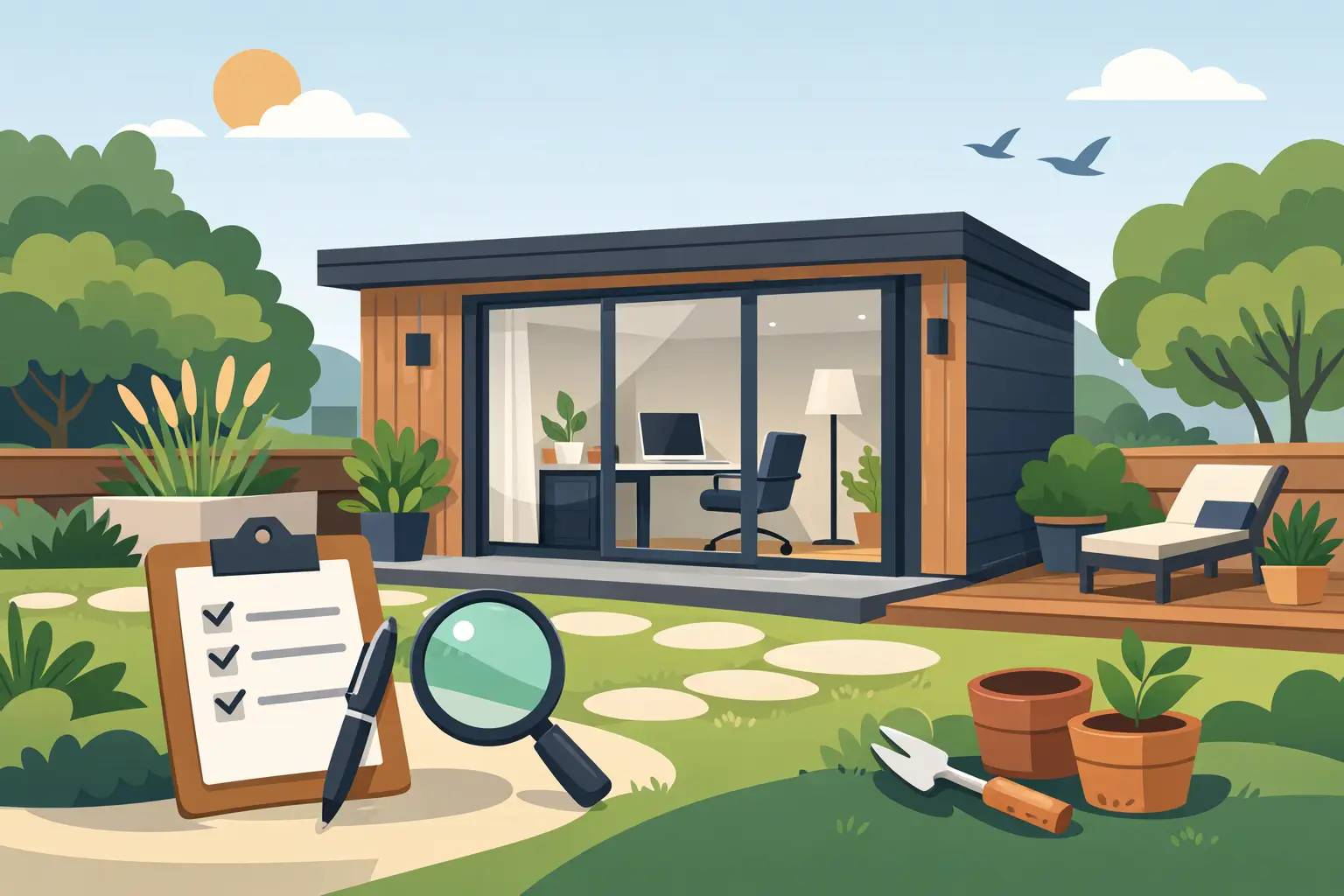
The wrong garden office looks fine on day one and starts asking for your time and money not long after. Paint peels, timber moves, the room feels too hot in summer and too cold in January, and what should have made home working easier becomes another job to manage. This composite garden office buyer guide is here to help you avoid that mistake and choose a space that works properly all year round.
For most UK homeowners, the appeal is simple. You want extra room without the disruption, delay and cost of a full extension. But not every garden office offers the same level of comfort, lifespan or day-to-day convenience. The material, build specification and design choices you make at the start will shape how the building looks, feels and performs for years.
Why a composite garden office makes sense
A garden office needs to do more than give you a desk outside the house. It has to be warm enough for winter mornings, cool enough for summer afternoons, quiet enough for calls and meetings, and smart enough to feel like part of your home rather than a temporary add-on.
That is where composite stands out. A well-built composite garden office combines the natural look of timber with a much lower maintenance burden. You get the visual warmth many buyers want, but without the same cycle of sanding, staining and repainting. For busy homeowners, that matters. You are buying extra space to simplify life, not create a fresh list of upkeep jobs.
There is also a longer-term value point. Composite cladding is chosen because it resists many of the issues that make traditional timber buildings harder to own over time, such as rot, warping and regular surface treatment. If you want a building that still looks smart with minimal effort, composite is a strong option.
Start with how you will really use it
The best buying decisions usually start with a simple question: what will happen in the room every week? If the answer is mainly laptop work and video calls, your priorities may be lighting, broadband access, heating and acoustic comfort. If the office will also be a client meeting room, creative studio or occasional guest space, the layout needs more flexibility.
This is where many buyers either overbuild or underspecify. A very large office can be tempting, but if you only need space for one workstation and storage, a smarter footprint may be better value and easier to position in the garden. On the other hand, going too small often shows up later when you add filing, a printer, shelving or a second desk.
Think beyond today. If your working pattern may change, or you want the room to double as a gym, hobby room or snug in future, it makes sense to build in that adaptability from the start.
Size, layout and position matter more than people expect
A garden office is not just about internal floor area. The way it sits in the garden changes how usable it feels. A modest building with good glazing, sensible access and the right orientation can feel far better than a larger one placed awkwardly in shadow.
South-facing glazing can bring in plenty of natural light, but too much glass in the wrong position may increase solar gain and glare on screens. North-facing spaces can be beautifully consistent for work, but may need careful lighting design to avoid feeling flat. It depends on your site, surrounding trees, neighbouring properties and how you use the room throughout the day.
Inside, layout should feel deliberate. Built-in storage can save space. Wider doors can make the building more flexible if you ever repurpose it. If you plan to spend full working days there, do not treat circulation space as wasted space. A room that allows you to move comfortably, open cupboards easily and step away from the desk will simply work better.
The specification is where year-round comfort is won or lost
This is the section many buyers rush, and it is often the most important. A garden office can look impressive in photos but disappoint badly if the wall build-up, insulation and roofing are not designed for proper all-season use.
Pay close attention to insulation levels in the walls, roof and floor. Heat loss rarely comes from one place alone, so the whole envelope matters. High-performance roofing is particularly important because the roof takes a lot of weather exposure across the year. Quality windows and doors matter too, both for thermal performance and for the overall finish.
It is worth asking not just what materials are used, but how the whole structure performs together. A comfortable office is the result of insulation, airtight construction, glazing quality and sensible heating working as one system. If you are aiming for a space that feels like a true extension of the home, the specification should reflect that.
A composite garden office buyer guide to maintenance and lifespan
One of the main reasons buyers choose composite is straightforward: less maintenance. That does not mean no care at all, but it does mean a far more hassle-free ownership experience than many traditional timber buildings.
With timber, the charm is real, but so is the workload. Surface treatments need repeating. Weather can affect appearance and stability. What seems like a lower-cost purchase at first can become more demanding over time. Composite is attractive because it is designed to reduce those ownership headaches while still delivering a warm, timber-style finish.
That said, not all composite products are equal. Appearance, surface texture, colour stability and overall finish can vary. Buyers should look closely at sample finishes, guarantees and the details of how the building is constructed. A low-maintenance promise is strongest when it is backed by quality materials and a clear, dependable build standard.
Bespoke design is not a luxury – it is often the smarter buy
Off-the-shelf buildings can suit some gardens, but many homeowners benefit from a bespoke approach. UK plots are rarely perfectly simple. You may be working around existing landscaping, fencing, access restrictions, privacy concerns or a need to match the style of the main property.
A tailored design lets you solve those practical issues properly. It can also help you make better use of the budget. Rather than paying for a generic layout and then compromising, you can focus spend on the features that matter most to you, whether that is larger glazing, a specific room depth, upgraded doors or a finish that complements the rest of the garden.
For buyers comparing options, this is a good point to remember: bespoke should not mean complicated. A specialist should make the process easier by guiding you through choices clearly and showing what is included.
Planning, access and installation
Many garden offices fall within permitted development, but not all do. Height, location, intended use and proximity to boundaries can all affect what is possible. If you are considering a larger building or something with broader residential use, planning requirements may be different.
It is also easy to focus on the finished building and forget the route to getting it installed. Access matters. Narrow side passages, level changes and existing garden structures can influence design and installation logistics. This does not always create a problem, but it should be considered early rather than late.
A good buying experience includes practical guidance here. The right supplier will talk through planning considerations, access, base requirements and lead times in a way that feels clear, not vague.
What drives cost
Price is shaped by more than size alone. Specification, glazing, doors, internal finishes, electrical options and the complexity of the design all play a part. So does the standard of insulation and the quality of the external finish.
That is why very cheap comparisons can be misleading. Two garden offices may look similar in a photo and perform very differently in real life. If one building requires more maintenance, has a lighter specification or is less comfortable through winter, the lower starting price does not tell the full story.
The better way to judge value is to think about total ownership. How often will you use it? How much upkeep will it need? Will it still feel like a premium part of the home in five or ten years? For many buyers, paying for stronger materials and a higher-spec build makes sense because the building is used constantly, not occasionally.
Choosing the right supplier
A garden office is a significant home purchase, so confidence in the supplier matters as much as confidence in the design. Look for clarity around materials, guarantees, what is included and how the process works from enquiry through to completion.
You should also expect practical support, not just attractive images. That means straightforward answers on planning, realistic pricing, sensible lead times and clear guidance on customisation. A specialist such as Composite Garden Studios should make the decision feel simpler by combining design flexibility with dependable construction and a low-maintenance ownership model.
The best garden office is not the one with the longest feature list. It is the one that suits your life, your property and your future plans without adding avoidable upkeep. Buy with that in mind, and your new space can feel less like an extra building in the garden and more like the room the house was missing.